Anime Legacy | Tragic Absence. Why is Essential. Greece Needs Its Own Studio Ghibli.2026-Part C’
Anime Legacy | Continuation from part B’:
5️⃣ Comparison: Why Anime Is Different
Japanese civilizational continuity
“Manga/Anime is not Japan’s break with its past, but the technological evolution of its ancient need to illustrate the invisible.”
1. From 12th-Century Scrolls to the Screen
Animation in Japan did not begin with technology, but with the art of Chōjū-giga (the first animal sketches on papyrus).
The connection: Anime maintains the linear aesthetic and emphasis on action that we see in traditional scrolls and later in Ukiyo-e (woodblock prints). The “continuity” here is the visual narrative that has remained recognizable for 800 years.
2. Shinto and the “Soul” of Things
The Japanese worldview is deeply animistic (everything has a spirit).
In Studio Ghibli films (e.g., Spirited Away), the spirits of the forest or river are not “fairy tales,” but the survival of ancient religious beliefs in the modern world. Animation allows these age-old concepts to remain alive in the everyday lives of young Japanese people.
3. The Bushido Code in a Sci-Fi Environment
Animation functions as a “transporter” of the moral values of the Samurai.
The continuity: The concepts of Giri (duty) and Ninjo (human emotion) that dominated Kabuki theater are transferred intact to series like Naruto or Gundam. The warrior changes form (from sword to robot), but the moral code remains the same.
4. Trauma Management (Atomic Bomb – Nature)
Japan has a unique continuity in the way it processes disasters (earthquakes, war).
“From the tombs of Pokrovka to the mountains of Delphi, history proves that the female warrior was never a ‘fantasy’. Animation today takes the baton, transforming archaeological finds into visual symbols. When we see an anime heroine holding a sword, we are not seeing a modern invention, but the cultural continuity of a reality that began thousands of years ago.”
Here, it’s valuable to address this: The Amazons weren’t some children’s fairy tale.
The Amazons: From Myth to Reality :
The Excavations at Pokrovka, Russia, conducted in the 1990s by archaeologist Dr. Jeannine Davis-Kimball, provided the first tangible evidence that the Amazons were not just a Greek myth, but were based on real female warriors of the steppes.
The Archaeological Evidence
• Weapons Burials: The burial monuments (kurgans) contained skeletons of women buried with full military equipment, including iron handaxes, swords, and quivers with bronze arrowheads.
• Physical Evidence: The skeletons had bow-shaped bones in their legs, indicating a life spent almost exclusively on horseback. Additionally, some skeletons bore battle wounds, such as an arrowhead lodged in their spine.
• Social Status: These women belonged to the Sauromatian and Sarmatian tribes. In contrast to the patriarchal societies of ancient Greece, women of the steppes held high positions as warriors, priestesses, and leaders.
http://www.silkroadfoundation.org/newsletter/vol2num2/greek.html
Why This Changes History
• Myth As Ancient Echo: The findings prove that Greek writers, such as Herodotus, did not invent the Amazons, but rather described (with some exaggeration) the war women of the nomadic tribes they encountered on the northern shores of the Black Sea.
• Reality confirms the Myth: While men said that the Amazons hated men, archaeology shows that they lived in mixed societies, but with equal roles in combat and protecting their herds.
1. Pokrovka and the “DNA” of the Archer. At Pokrovka, the skeletons were found with curved bones from horseback riding and quivers full of arrows. Anime Connection: This historical archery model survives in characters like Kikyo (Inuyasha) or Ashitaka (although male, the aesthetic of mounted archery is central to Ghibli). In anime, archery is not just a weapon, but a symbol of spiritual concentration and independence, reflecting the true autonomy of women of the steppes.
2. Aetolian Women at Delphi: Collective Defense Historically, during the Gaulish invasion of 279 BC, Aetolian women actively participated in the defense of Delphi, protecting the “navel of the earth.” Anime Connection: This is reminiscent of the “Defender of the Hearth” archetype. In anime like Attack on Titan (Mikasa) or Claymore, female warriors do not fight for glory, but because they are the last line of defense of their society. Just as the Aetolians protected the sanctuary, so anime heroines become “holy guardians” when traditional structures collapse.
3. The Onna-musha Archetype as a Bridge Japan has its own historical basis for female warriors, the Onna-musha (like Tomoe Gozen), who, like the Amazons of Pokrovka, were trained in weapons to defend their homes and families. Connection: The Anime takes these three elements—the autonomy of the Amazons, the sacrifice of the Aetolians, and the discipline of the Onna-musha—and synthesizes them into a modern mythology.
Demon Slayer (Kimetsu no Yaiba): The ultimate success of the last few years is based on traditional Japanese folklore (demonology) and the aesthetics of Ukiyo-e (e.g., the water that comes by Tanjiro’s sword resembles Hokusai’s “Great Wave”).
Princess Mononoke: This film explores themes of exile, the “coming of age” journey, and the primal conflict between Man and Nature. The animation breathes life into the ancient Kami (deities) of Japan, demonstrating that the values of Shintoism remain deeply relevant in the context of today’s ecological crisis.
Ghost in the Shell: Despite its futuristic cyberpunk setting, its core inquiry—the location and nature of the “soul” (the Ghost)—represents a modern evolution of Buddhist philosophy regarding the nature of consciousness.
The Connection: From Akira to Your Name, anime serves as a medium conveying Japan’s collective trauma. It is the primary way in which the culture “talks” to itself about its past, utilizing art as a vessel to preserve memory and navigate the future.
Profound Symbolism in anime (miko, uniforms, paradoxes)
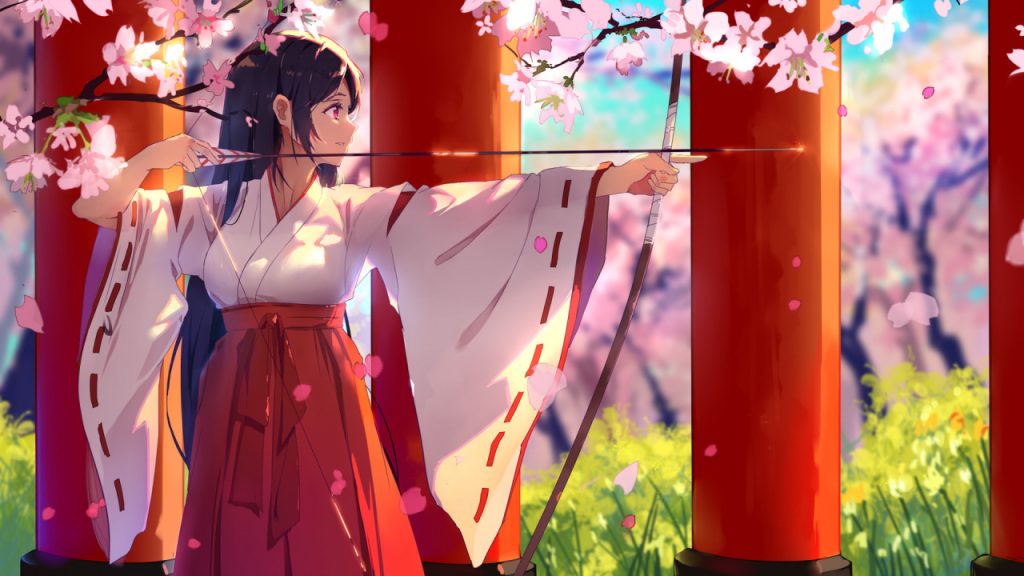
Symbolism in anime is never accidental; it functions as a “visual language” that connects the modern viewer with deep cultural meanings.
1. The Miko (Priestess): The Bridge of Worlds
The figure of the Miko (with her characteristic red hakama and white kosode) is the strongest symbolism of purity and metaphysical power.
Symbolism: In anime (such as Your Name or Inuyasha), the Miko represents the connection of the modern world with the divine and tradition. She is the “guardian” who maintains spiritual balance in the face of chaos.
2. School Uniforms: Uniformity vs. Identity
The school uniform is perhaps the most recognizable symbol in anime, but it hides a paradox.
Symbolism: It represents social class and the transition from childhood to adulthood.
The Paradox: While uniforms enforce uniformity, anime creators use them to show rebellion. A loose tie or a short skirt becomes a symbol of individuality within a rigid system.
3. The Paradoxes
Anime loves to combine opposite elements to create meaning:
Technology vs. Nature: Robots (Mecha) that have a “soul” or forests that attack cities. This reflects the Japanese paradox: a technologically advanced country that remains deeply spiritual.
Fragile Appearance vs. Enormous Power: Petite heroines wielding enormous swords (like the Amazons we discussed). This symbolizes the inner power (Ki) that does not depend on physical build.
4. Colors and Elements of Nature
Cherry Blossoms (Sakura): Symbolize the transience of life (mono no aware). A scene with falling petals always portends a significant change or a farewell.
Hair: Hair color often symbolizes personality (e.g., red for passion/aggression, blue for introspection/coldness).
1. The Paradox of the Warrior (Amazon / Miko)
In Anime, the female warrior often embodies the paradox of “Sacred Violence”.
Just as the Amazons of Pokrovka were both mothers/women and tough horsemen, so too the Miko (e.g., Rei Hino in Sailor Moon or Kagome in Inuyasha) combines absolute spiritual purity with the ability to annihilate enemies.
This paradox reinforces the scenario by creating internal conflict: The heroine must maintain her femininity or holiness, while at the same time, her hand must be ruthless in battle. This makes her three-dimensional and not a simple “killing machine”.
2. Visual Symbols: From Aetolians to Modern Heroines
There are specific visual elements that “translate” historical valor into anime aesthetics:
The Shared Visual Language of Heroism[the anime image below is mine, I used AI]
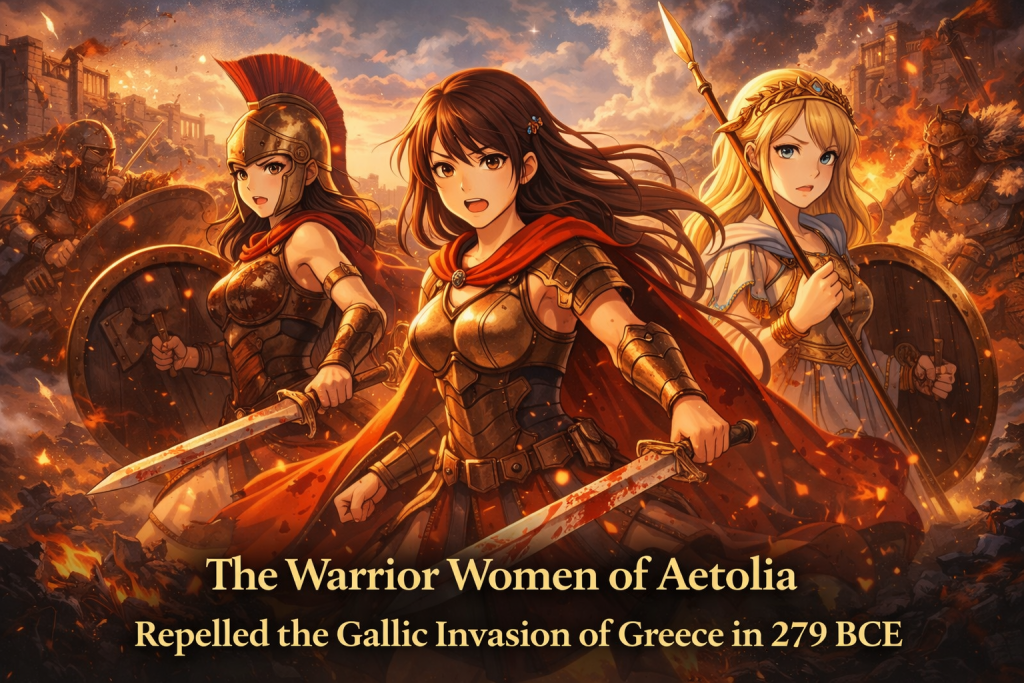
The Crimson Symbol: In ancient tradition, Aetolian women were associated with the protection of the sacred site of Delphi. In anime, this “sacred protection” is often mirrored in the use of red—whether in the attire of warriors or the hakama of the Miko (shrine maidens). The color symbolizes both the blood of sacrifice and a ritualistic defense against evil.
The Broken Attire: Ancient warriors were frequently depicted with a “disheveled” appearance after combat as a mark of authenticity and grit. Similarly, in anime, “battle-damaged uniforms or broken armor—serve as a symbol of honor. It signals that the heroine has transcended the limits of “decency” or physical comfort to fulfill her higher duty.
The Fierce Gaze: Just as Amazons in Greek vase painting exude a distinctive, determined stare, anime translates this intensity through “the gaze.” This often manifests as oversized, piercing eyes that shift in color or shape (such as the Sharingan) when a character enters a state of combat, effectively linking physical prowess with divine or supernatural intervention.
The Archetypal Bridge. These symbols act as subconscious bridges. The viewer may not be versed in the geography of Pokrovka or the complex rituals of Delphi, yet the archetypes on the screen resonate instantly. Because they are not mere fictions; they are rooted in historical truths thousands of years old. When animation channels these primal symbols, it bypasses the need for academic knowledge and speaks directly to the collective subconscious, proving that ancient heritage is not a fossil, but a living, breathing blueprint for modern storytelling.
Why Anime Exceeds “Western Cartoons”?
Civilizational Depth:
• The “big eyes” motif in manga is often attempted to explain through modern lenses: Disney influence, printing constraints, emotional readability, or commercial appeal. While these explanations are not incorrect, they are incomplete. They overlook a deeper, older idea — one that predates modern Japan, modern art, and even modern psychology. The roots of this visual language can be traced back to ancient ethical philosophy, particularly traditions that linked physical appearance with inner virtue.
• One striking articulation of this idea appears in the Anthology of Stobaeus, Volume 10, in a passage attributed to Nikostratos, titled “About Marriage.” In it, Nikostratos describes the customs of Indian sages — “the bare and the wise” — who do not choose women for wealth, lineage, or social glory. Instead, they observe a woman’s appearance, especially her eyes, not out of lust, but through a disciplined, philosophical gaze.
• “Because it’s not convenient for the newlywed man to see what the manners of women will be, the Indian men and their wisemen proceed with the following method, and they’ve never been tricked. Those, the Indian men, the bare and the wise, they never get married on purpose for the wealth, and the glory of any wealthy Indian man, but they study the woman, her appearance, and her beauty. And as they do this by some profound mentality, not by lecher, nor by the criteria we apply. Because the benevolent eyes reflect the beauty of the soul. And it’s not easy to be on a face joyful and clean when you get indignant, enraged, and embittered.”
• As the ancient text continues, he provides us with examples
• “As I don’t recommend the handsome and the beautiful, but following the belief of the Indian, I can’t otherwise express myself.
Depth of themes- Reclaiming the Icons: Beyond the “Cardboard” Greek Myths
While Greek television budgets are spent on stagnant domestic dramas, Fate/stay night takes our ancestral legends and restores the “High Tragedy” that made them world-famous. Local productions often present mythology as a sterile classroom lesson; Fate presents it as a visceral struggle of the soul.
It does not offer “moral values” in the form of a preachy Sunday school lesson; it offers a brutal, Aristotelian interrogation of the human soul. To watch Fate is to witness the Clash of Ideals: the protagonist, Shirou Emiya, isn’t a plastic hero; he is a study in Survivor’s Guilt and the existential tragedy of Hubris. The series is also unique for its three-route structure (Fate, Unlimited Blade Works, and Heaven’s Feel). Instead of a single sequel, it tells the same two-week period three different ways to show how a single choice can fundamentally change a person’s morality and destiny.
- Heracles: The Price of Redemption
In the headcanon of most local media, Heracles is distorted to a hollow action figure defined by muscle. Fate summons him in the Berserker class, a brilliant narrative choice that mirrors his original tragedy. By stripping away his speech and sanity—a direct reference to the Hera-induced madness that forced him to kill his own family—the show makes his Twelve Labors feel earned. He is not just “strong”; he is a man so tormented by his past that he has turned his body into a fortress to protect a young girl, Illya, finding a shred of humanity even in madness. - Medusa: The Victim Behind the Monster
Instead of the typical “monster of the week,” Fate explores the Gorgon’s tragedy through Rider. Drawing from Ovidian themes of divine abuse, the series portrays her not as a villain but as a victim of divine jealousy and isolation. Her Noble Phantasm, Bellerophon, isn’t just a cool attack; it represents the Pegasus that was born from her own tragedy. - Medea: The “Witch” Who Only Wanted a Home
While Greek soap operas focus on modern betrayal, Fate’s Caster (Medea) is the ultimate study of betrayal across time. The series leans into who was. Her struggle to find genuine love and security in the modern world is a more complex “drama” than anything currently airing on local networks.
Mythology Meets Modernity: Anime like Nausicaä (inspired by The Odyssey) or Attack on Titan (a Greek thriller-esque manga)mirrors how Japan blends Shinto Mentality, Buddhist philosophy, and post-war existentialism into storytelling.
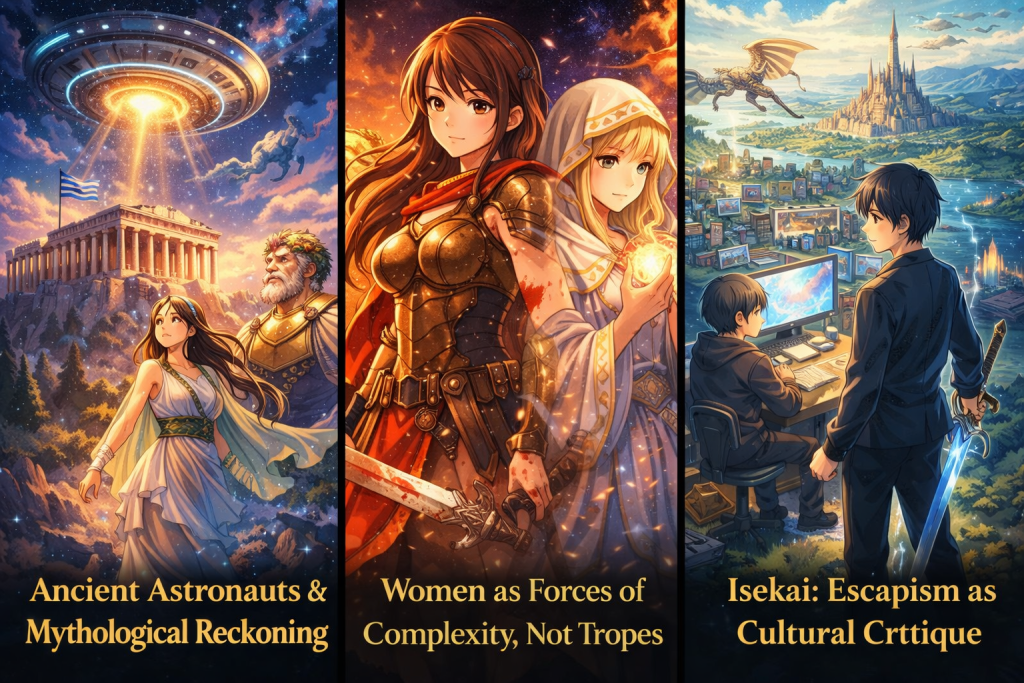
Complex Archetypes: The miko (shrine maiden) or kunoichi (female ninja) aren’t just “cool” tropes—they’re rooted in Japan’s history of female spiritual and martial authority (e.g., Himiko, the shaman-queen). This contrasts with Western cartoons, which often reduce female characters to sidekicks or love interests.
Aesthetic Philosophy: The school uniform (seen in Sailor Moon or K-On!) symbolizes Japan’s balance of collectivism and individualism. As Saitō Tamaki argues in Beautiful Fighting Girl, these characters embody a “postmodern” interplay of strength and vulnerability absent in many Western works.
• Moral Ambiguity: Unlike Western cartoons’ clear heroes/villains, anime (Neon Genesis Evangelion, Monster) explores gray areas—grief, trauma, ethical dilemmas—trusting audiences to grapple with complexity.
- Ancient Astronauts & Mythological Reckoning Image
• Gall Force’s Cosmic Mythology: The trilogy’s fusion of ancient aliens, war, and cyclical rebirth mirrors Japan’s comfort with reinterpreting myths (e.g., Evangelion’s Kabbalah/Shinto mashup). Greece, meanwhile, treats its own myths as static museum pieces. Imagine a Greek anime where the Olympians are revealed as interstellar beings (as in Battlestar Galactica’s “All Along the Watchtower”), forcing modern Greeks to question their identity.
• Why Greece Struggles: Greek culture often conflates “respect” for antiquity with rigidity. Anime’s fluidity—treating myth as a living, mutable language—could liberate Greek creators to ask: What if the Minotaur was a genetic experiment? What if Odysseus encountered a black hole instead of sirens?
2 Women as Forces of Complexity, Not Tropes Image
• Bubblegum Crisis/Grisaia’s Blueprint: The Knight Sabers and Phantom Trigger operatives are neither “strong female characters” nor male fantasies. They’re professionals navigating trauma, ethics, and power—akin to Kill la Kill’s deconstruction of empowerment vs. exploitation.
• Greek Contrast: Greek media often reduces women to the virgin, nag, or tragic mother. Namely, the damsel in distress. Anime’s nuanced heroines (e.g., Ghost in the Shell’s Major, Psycho-Pass’ Akane) could inspire Greek stories where an all-women team of commandos fights, against all odds, to defend Greece’s territorial sovereignty.
3 Isekai: Escapism as Cultural Critique Image
• The Genius of Parallel Worlds: Series like Re: Zero, or Mushoku Tensei, use isekai to dissect modern alienation, privilege, and redemption. Greece’s own Odyssey is the original isekai—a man trapped between worlds, reshaped by trauma. Yet modern Greek TV lacks equivalents.
Narrative Opportunities: The Modern Myth
- The Isekai Concept: Imagine an isekai where a disaffected teenager from modern-day Thessaloniki is thrust back into the Byzantine Empire. Forced to reconcile Greece’s glorified history with its chaotic present, the story would use the lens of “portal fantasy” to reframe the Greek crisis through a blend of historical epic and existential dread.
- The Displaced Heroine: Alternatively, imagine an ancient Greek shrine maiden magically transported to contemporary Athens. Her unwavering personality and ancestral spiritual power could provide the very spark needed to turn the tide of a modern national crisis.
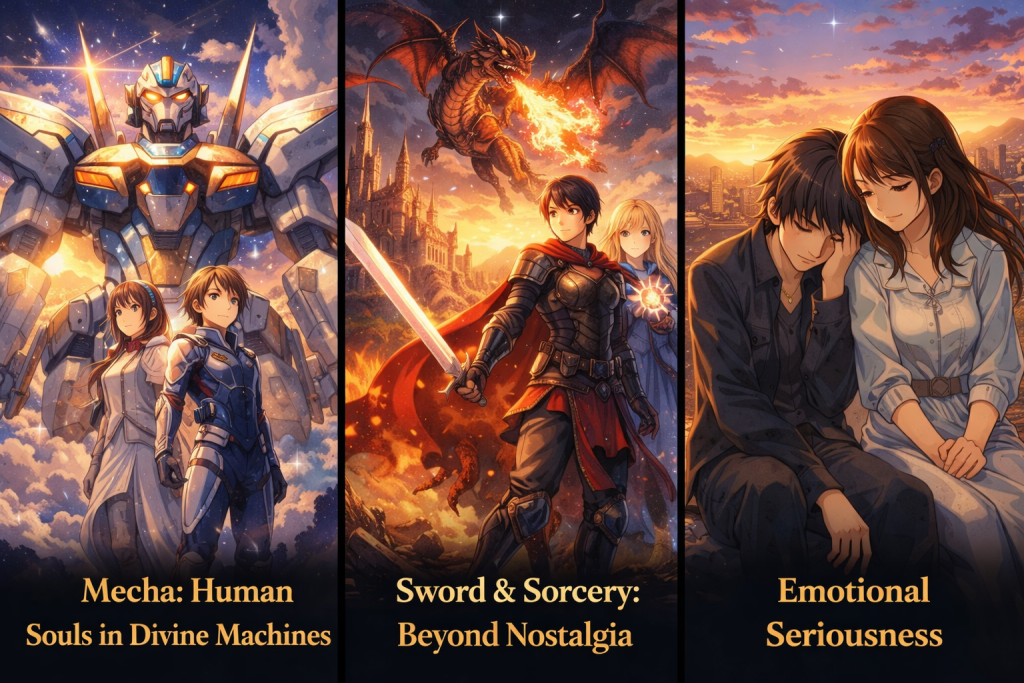
- 4 Mecha: Human Souls in Divine Machines
- Existential Mecha (The RahXephon Model) Unlike Western depictions of mechanized warfare—which often focus on the tactical, military, or industrial power of the machine—the Japanese mecha genre (seen in masterworks like Evangelion, Code Geass, and RahXephon) utilizes the robot as a vessel to explore profound themes of identity, grief, and divinity. In these narratives, the “machine” is not just a weapon; it is an extension of the human soul and a mirror for the character’s internal struggle. RahXephon’s emphasis on music and ritual echoes the structure of ancient Greek tragedies, where heroes often find themselves as “puppets of fate” grappling with higher powers.
- The Greek Potential: The mecha genre could be the perfect vessel to resurrect Greece’s philosophical roots. Picture a series where students pilot Titan-shaped mechs powered by human spirit and communal joy, battling corporate drones in a struggle for the Aegean—a powerful metaphor for the clash between commodified culture and Dionysian passion.
5 Sword & Sorcery: Beyond Nostalgia
• Japan’s Genre Alchemy: Series like Berserk (existential despair), Made in Abyss (innocence vs. horror), or Claymore (gender/body horror) reinvent medieval fantasy by asking: What does power cost? Who is the real monster?
• Greece’s Untapped Myths: Greek sword-and-sorcery could transcend Hercules parodies. Reimagine the Argonautica as a Game of Thrones-style epic where Jason’s crew are morally gray mercenaries, or Circe as a witch battling patriarchal gods in a Mad Max-style wasteland.
We need to clarify, to cease the panic about sacred symbols:
The Star pentagram is a benevolent prehistoric Greek symbol. The Soumerians, as descendants of Pelasgian Greeks, had used it. It was also applied by Pythagoras and his court of students.
Definition and Name: The word “pentagram” indicates that the symbol consists of five alphas (A) intertwined. It is a geometric figure (pentagram) formed by the diagonals of a regular pentagon. Pythagorean Symbol: For the Pythagoreans, the pentagram was the ultimate symbol of recognition among the members of their school. The emblem of health, harmony, and perfection.
HEALTH: The Pythagoreans often identified the pentagram with the concept of “Health”. The five vertices of the symbol corresponded to the five letters of the word Y-G-I-E-A. Cosmic Elements: In Pythagorean philosophy, the pentagram symbolized the five elements that define the human and the world: earth, water, air, fire, and the Platonic idea (or “warmth”).
Golden Ratio: This symbol is considered to embody the “Golden Ratio”, a fact that confirms the ancient Greek obsession with mathematical perfection.
The ouroboros serpent (or simply ouroboros) has deep roots in ancient Greek thought and literature, although its first appearance is traced back to Egypt. The Greek contribution is decisive, as it gave the symbol its name, its philosophical dimension, and its importance in alchemy.
Here are the main points of the Greek origin of the ouroboros:
1. Etymology and Name
The word is purely Greek, composed of the words:
Οὐρά (tail)
Βορος (from the verb vibrōsko/βόρω – to eat, devour).
That is, it means “the one who eats his own tail”.
2. Ouroboros and Ancient Greek Philosophy Plato: In Timaeus, Plato describes the first living being in the universe as a being without need for members, as everything it needed was within itself. This “perfect” being, which needs nothing else to survive, is often identified with the image of the ouroboros.
Eternal Return: In Greek thought, the ouroboros symbolized the eternal cycle of time, the eternal return, and the unity of the universe.
3. Hellenistic Alexandria and Alchemy
The symbol gained immense importance during the Hellenistic period in Alexandria, associated with Hermeticism and Alchemy:
“The All is One”: In the 3rd century. AD, in the alchemical text Cleopatra’s Goldsmith’s Work, the ouroboros appears with the phrase “In the All”, symbolizing the unity of matter, rebirth, and the eternal cyclical process of alchemical transmutation.
Symbol of the soul: It was often depicted half black and half white, representing the union of opposites.
4. Connection with Mythology
The Pelasgians, who had civilized Egypt and left a mark there, the benevolent symbol. In Greek tradition, it was associated with deities related to time and nature, such as Dionysus (as the cycle of nature) and Aeon (the personification of infinite time).
Summary
The ouroboros, through Greek philosophy and alchemy, was transformed from a simple Egyptian cosmological symbol into a profound philosophical symbol of the cycle of life, death, and eternal rebirth.
So, they didn’t connect to evil or the occult, which appeared much later.
Emotional Seriousness
1. Acceptance of Tragedy (Mono no aware)
In contrast to the classic “happy ending”, manga and anime often embrace melancholy. The concept of “Mono no aware” (sensitivity to the ephemeral) teaches that beauty lies in the fact that nothing lasts forever.
Example: The death of a beloved teacher or heroine is not just a plot point, but an opportunity for the reader to experience grief and maturity (e.g., Naruto, Your Lie in April).
2. Grey Morality
True emotional resonance stems from the realization that there is rarely an absolute ‘good’ or ‘bad.’ By moving beyond the binary of hero and villain, storytelling can explore the nuanced ‘grey zones’ of human motivation. This moral ambiguity reflects the complexity of the real world, allowing the audience to empathize with the struggles of every character, regardless of their allegiances.
Connection to the Amazons: Just as the Amazons of Pokrovka were not “evil invaders” but people fighting for the survival of their race, so too do the “bad guys” in anime (like Itachi or Meruem) often have tragic motives that evoke deep empathy.
3. The Burden of Choice
The characters are faced with dilemmas that have real emotional costs.
Symbolism: Seriousness is seen in moments of silence. Manga often uses blank panels or close-ups of the eyes to convey inner pain, without words. This requires an “emotional investment” from the reader that goes beyond simple entertainment.
4. The Connection to Reality
Even in the most fantastical scenarios (Sci-Fi/Fantasy), emotions are raw and real. Depression, loneliness, fear of failure, and the need for acceptance are treated with a seriousness that reflects the social pressures of modern Japan (and the world).
If ‘moral values’ consist only of blind obedience to rules, then perhaps a telemarketer’s manual is enough. But if moral values are about the agonizing weight of choice, the responsibility of power, and the courage to find individual truth in a world of conflicting ‘goods,’ then Fate/stay night offers a more rigorous ethical education than any live-action soap opera currently airing in Greece.”
Leave a Reply