
Synopsis:
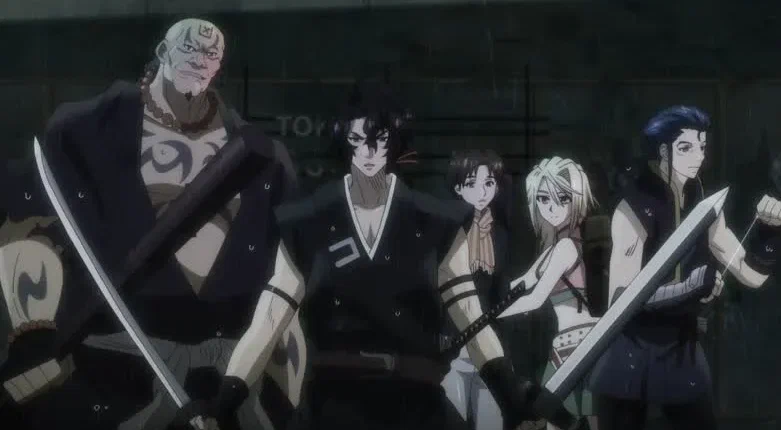
In 2030, Japan, a virus known as “Gibia” has infected humans throughout the world and turns them into different forms of monsters based on their age, sex, and race. A samurai, a ninja, and a monk from the early Edo period travel through time and arrive in a ruined Japan. They aid a professor working on a cure for the virus and face ceaseless attacks from Gibias. They start the dangerous journey to find other survivors and must not only deal with monsters, but also outlaws that attack travelers for food.”
When Gibiate was first announced, it had the markings of a bold, high-stakes anime: time travel, historical warriors from feudal Japan, a mysterious virus of alien origin was turning humans into monsters, and the clash between ancient honor and modern catastrophe. However, as many of its viewers — including myself — have come to conclude, the anime failed miserably.
Why? How did it happen? Did the production Studios lack budget and artists to do the work right? Or were the incompetent the voice actors? None of these.
A Promising Concept… Gone Awry
The idea of placing legendary Japanese warriors (a samurai, a shinobi, and a monk)arriving, from their time, into a post-apocalyptic world ravaged by a virus seemed thrilling in the manuscript. The contrast of their bushido values with a crumbling modern society had real dramatic potential. This sounded like an echo of Fist of the North Star, Samurai Jack, Spider-Man/Red Sonja crossover, and even Resident Evil. But potential alone doesn’t necessarily save a story- positive execution and message are what matter most.
The Terrible Flaw: Evil Wins
Then again, one of the deepest factors of Gibiate‘s failure was the core message conveyed by the ending — or more precisely, the lack of a great ending, with an earned victory.
In episode 11, a long-overdue revelation happens: When the journeying protagonists, Sensui and Kenroku, cause the death of the monstrous Meteora. On this commotion comes ” Doctor Yoshinaga.” Seeing her dead, he gets enraged, so he admits he is an extraterrestrial posing as a human. As he coldly admits, he had them wrapped in his malicious agenda. He utilized people’s hope, fooling everyone, with his forgery that with the Gibia stings, “he would produce the human-saving vaccine.” He would make a formula to restore intellect to the Gibia. Eventually, he would return to his planet with his lover, Meteora. Angered, he saw that what mattered was to kill them all.
The alien commenced a vile rampage on the humans. In the ensuing struggle, most of the human team is killed. Sensui and Kenroku kill Yoshinaga. But the nightmare remained: More Gibia are coming, and no one has made the human-saving vaccine. As Kenroku and Kathleen board a boat, they briefly separate from Sensui (who has to fight against the Gibia) with a promise that someday they will reunite(will they really after all these?).
My Comment
Time after the anime, I noticed this: None of the travelers, including the vlogger Kathleen , ever got suspicious of the unfazed ‘Dr.Yoshinaga.’ Everyone can feel strained during such a nightmarish time, and losing their comfort during the journey to make the “human -saving vaccine”. How come none saw through him? Why could he remain uncannily calm, like their suffering never meant anything to him?
After 12 episodes of uneven pacing, inconsistent animation, and flat character arcs, the climax lands a blow to the gut of anyone hoping for redemption or triumph. Evil wins. The virus persists. The heroic sacrifices are rendered meaningless. Humanity is doomed.
And worst of all?

The badass warriors from the past — whose arrival should symbolize hope, courage, and change — are swallowed by the same cruel, final fate that engulfed the modern world. Instead of inspiring a future, they fall victim to a hopeless narrative loop.


Why This Message Failed So Hard
While tragic or bittersweet endings can be powerful (Attack on Titan, Devilman Crybaby, or The End of Evangelion come to mind), Gibiate didn’t earn its ending. The show lacked proper emotional build-up, world-building depth, and character growth. As a result, the dark finale came off as unearned and emotionally hollow — a twist for shock’s sake.
Worse yet, it undermined its own premise: if even Japan’s greatest heroes — those forged in the crucible of survival, war, and bushido — can’t stand against a modern evil, what hope does humanity have?
A Failure of Execution Across the Board
On top of its thematic failure, Gibiate suffered from:
- Inconsistent and outdated animation
- Weak dialogue and exposition-heavy writing
- Poor pacing (some moments dragged while others rushed)
- Underdeveloped characters with flat motivations.
Conclusion: A Lesson in Narrative Responsibility
Anime fans are no strangers to sadness, orphancy in early years, or loss in storytelling. Avid readers of shounen manga can be familiar with the tragic backstories of heroes, antiheroes, and antagonists as well. But Gibiate felt like an infuriating betrayal of its own setup, and a huge cheat of the viewers. The vile message was loud and clear — “heroism doesn’t matter, and evil can’t be stopped.”
In the end, Gibiate will likely be remembered not for its artistic risks but for how it shamefully wasted them.
See an early post of mine, about tragedy:
#Gibiate #Anime Review #Anime Fail #Apocalypse Anime #Samurai Anime #Gibiate Analysis #TimeTravel Anime #Narrative Criticism #Japanese Animation #Tragedy #Anime Study #Narrative Responsibility #ジビエート
The concept of societal breakdown due to a virus transforming people is really interesting, and the Edo period travelers add a unique element. I found some related strategic thinking about surviving chaotic scenarios discussed on https://tinyfun.io/game/tank-battles, which might appeal to fans of this type of premise.
Hi,welcome to our site. We appreciate your friendly words.
I simply couldn’t go away your site before suggesting that I actually loved the standard info an individual supply in your visitors? Is gonna be again continuously in order to investigate cross-check new posts
It’s a joy how you commented. I’ll keep in the game:)