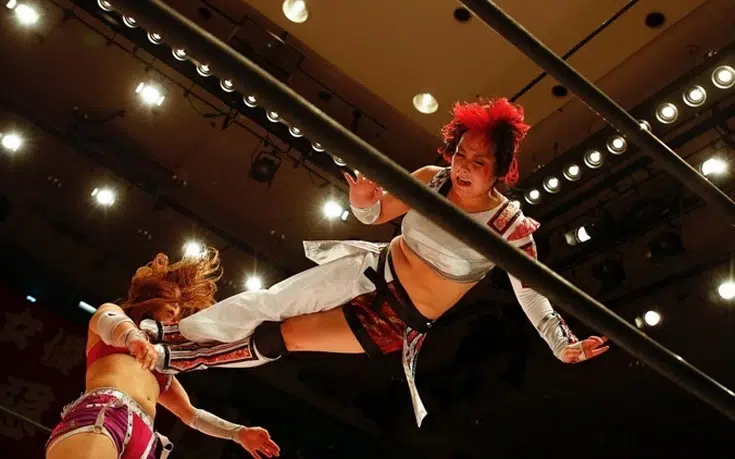
Stardom Joshi | Beyond the neon lights of Tokyo lies a world where the elegance of a dancer meets the ferocity of a warrior. I first glimpsed this through the statement of Kris Hernandez, best known by the ring name Kris Wolf *1, seeing the sweat and silk of Stardom https://www.newsbeast.gr/woman/arthro/2198482/otan-i-giaponezes-palevoun. In this article, Reuters photographer Thomas Peter captured her and other female colleagues in stunning shots from incredible moments inside the ring. It is a window into the Japanese soul—a place where discipline is a craft and every brutal strike is a testament to a deep-rooted civilization that respects the art of the struggle.

##My first notices on Stardom Joshi from 2016 In April of 2016. https://www.newsbeast.gr/woman/arthro/2133230/agria-thilika-palevoun-se-ena-atipo-fight-club I first learned about the amateur women’s fight club in Berlin, Germany. This club was founded by Anna Konda και Red Devil in Berlin. Just two months later, in April, I read about Stardom Joshi. That was more captivating and impactful. I searched on YouTube, Dailymotion, and Twitter to see more of it.

##Stardom Joshi is more than a spectacle.
It wasn’t just strength or spectacle. It was precision, discipline, and an almost spiritual commitment to craft. Stardom Joshi wasn’t trying to imitate Western wrestling—it existed on its own terms, rooted in Japanese values of ganbaru (perseverance), respect, and self-mastery. In the West, wrestling is often framed as a soap opera with stunts. In the ring of Stardom, it is framed as a struggle for identity. These women are not presented as novelties or gimmicks. They are athletes, artists, and storytellers. Their bodies are not just tools of impact, but instruments of expression.A certain kaizen.
##The Eras of Stardom Joshi: A Decade of Transformation (2016–2026)
2016–2019: The Threedom Era & International AwakeningThe era of Io Shirai, Kairi Hojo (Sane) and Mayu Iwatani who put Stardom on the global map.
The Threedom: The Architects of the Sacred Space
The foundation of Stardom’s modern global identity was forged by three distinct spirits, collectively known as The Threedom: Io Shirai, Kairi Hojo, and Mayu Iwatani. Together, they elevated Stardom Joshi from a domestic promotion to a global standard of excellence. They were the Holy Trinity of the ring, each embodying a different element of the “Beautiful Brutality.”
Mayu Iwatani (The Icon of Stardom): While Io and Kairi eventually took their talents across the ocean to global screens, Mayu remained. She is the living embodiment of ganbaru (perseverance). Mayu’s story is one of survival; she takes the most terrifying bumps, absorbs the most brutal strikes, and always stands back up. She became the anchor of Stardom, the bridge connecting its past to its 2026 future.
2019–2022: The Bushiroad Takeover & Stadium EraThe Bushiroad takeover, the move to larger stadiums (Nippon Budokan), and the tragic but influential legacy of Hana Kimura.
Io Shirai (The Genius of the Sky): Io was the definition of absolute precision and self-mastery. Watching her wrestle was like watching a master artisan at work. She brought an unmatched athletic gravity to the ring, proving that women’s wrestling could be more complex, sharper, and more devastating than anything seen in the West. She was the standard-bearer of discipline.
Kairi Hojo (The Pirate Princess): Kairi brought the theater, the emotional narrative, and the unbreakable spirit. Her diving elbow drop wasn’t just a move; it was art. She connected with the audience on a deeply human level, showing that vulnerability and fierce bravery could coexist. She was the heart of the promotion, carrying the emotional weight of every story.
The Neon Cyberpunk and the Soul of Stardom: Hana Kimura
To speak of Stardom’s evolution without speaking of Hana Kimura is to leave the ring without its heart. She was the vivid explosion of neon pink in a world of traditional discipline, a cyberpunk goddess who embodied the modern spirit of Stardom Joshi.
Hana did not just wrestle; she captivated. Her charisma was democratic—it transcended the boundaries of language and geography, reaching global fans who only knew her through a screen. In the ring, she blended the ferocious lineage of Japanese joshi with a style that was entirely, unapologetically her own.
When the world lost her in 2020, the tragedy felt personal to thousands who had never met her. But as we look at the decade spanning 2016 to 2026, her legacy is not defined by darkness. It is defined by her slogan: “Everyone is different, everyone is special.” She remains the eternal reminder that beneath the “Beautiful Brutality” of the sport lies a profound, fragile humanity. She forced the world to look at wrestling not as a sideshow, but as an art form capable of producing generational icons.
2022–2026: Global Expansion and the Modern Spirit.The establishment of Stardom as the premier women’s league in the world, the partnerships with AEW/New Japan, and the new generation of wrestlers
##The Eras of Stardom Joshi: Global Renaissance and the Infinite Ring
Entering the mid-2020s, Stardom Joshi shattered the remaining borders between domestic mastery and global dominance. This era became defined by cross-promotional battlegrounds, historic crossovers with New Japan Pro-Wrestling, and the birth of the IWGP Women’s Championship. The “Beautiful Brutality” was no longer a hidden Japanese treasure; it became a global language.
In this modern landscape, new icons stepped into the light to carry the torch. Wrestlers like Giulia brought a raw, dangerous intensity that redefined modern violence in the ring, while the sub-factions evolved into complex ideological houses. By 2026, Stardom proved that its philosophy could survive corporate shifts, global expansion, and the departure of older legends. The ring remains a sacred space, proving that as long as there is a canvas, the spirit of ganbaru will never fade.
This “Beautiful Brutality” is found in the contrast. You see a wrestler enter in an elaborate, shimmering gown that would look at home in a high-fashion editorial, only for her to engage in a level of physical stoicism that would break a lesser athlete. Pain is acknowledged, not hidden. Loss is not erased, but transformed into resolve. Victory is earned through a series of “strikes”, “body blows,” “hard impacts” that echo the rhythmic intensity of a blacksmith forging steel.
##Stardom Joshi is rooted in the Japanese civilization,a kaizen.
his culture understands repetition and endurance—not as punishment, but as refinement. Watching a Stardom match feels closer to witnessing a traditional Noh performance or a tea ceremony than consuming mass-market entertainment. Every movement matters. The sound of a forearm,the way of a dropkick,how german suplex is executed with impact, the way a wrestler stands still and absorbs, the visual of silk against sweat and bruises. Every scar tells a story of a “spirit” that refuses to be extinguished. When a wrestler takes a blistering forearm to the chest, she doesn’t just recoil; she absorbs the energy, a physical manifestation of the Japanese proverb: “Fall seven times, stand up eight.”
This inaugural post is not about rankings, championship statistics, or match results. It is about why Stardom Joshi matters on a human level. It is about recognizing a form of women’s wrestling that refuses simplification and demands respect. It is about strength without cynicism, beauty without fragility, and violence without emptiness.By the way,take a read on my related,well tied to topic post,https://mangaanimeblogger.com/joshi-puroresu-sekatsuyo/
##Stardom Joshi,where the ring is precious.
In the world of Stardom, the ring is a sacred space where the superficialities of the modern world are stripped away, leaving only the truth of the struggle. For the bloggers and fans at my hub, “Ashitaka’s Shrine,” this is the beginning of a deep dive into a phenomenon that is as much about philosophy as it is about sport. To truly understand it is to understand the language of the ‘fighting spirit.’ In the West, we are accustomed to heroes of comics overcoming the villain.
## Stardom Joshi is endurance during all the fight.
Still in the Japanese ring, the most profound story is often told through how a wrestler absorbs punishment. When you see a wrestler stand motionless, inviting her opponent to strike her with everything they have, it isn’t masochism. It is an elite display of ‘fudo’—immovability. It is a visual representation of a soul that cannot be shaken, regardless of the physical toll. This connection between the performer and the audience is a silent dialogue of respect. The fans do not just cheer for the winner; they applaud the struggle itself. They recognize the years of training, the thousand repetitions of a single dropkick, and the cultural weight of representing Japan on a global stage. By looking past the surface of ‘entertainment,’ we find a disciplined path where the ‘Beautiful Brutality’ serves as a mirror, reflecting our own human capacity to endure, to evolve, and to shine under the hardest of circumstances.”
This is the beginning of my journey into Stardom Joshi. More posts will follow—exploring the individual legends, the intricate match philosophies, and the quiet power that lives between the ropes. For now, this is my opening bow.
*1:She wrestled for World Wonder Ring Stardom in Japan, where she is a former High Speed Champion, as well as a founding member of the Oedo Tai stable
Leave a Reply