Continuation from previous post: Anime Legacy | Tragic Absence. Why is Essential? Greece Needs Its Own Studio Ghibli. 2026-Part D’. https://mangaanimeblogger.com/anime-legacy-greece-needs-its-ghibli-part-d/
8️⃣The Deeper Question: Does Greece lack Cultural Confidence?
In Japan, there was Tezuka Osamu; in America, there was Walt Disney. In China, there were the Wan Brothers, and in Iran, there is Ashkan Rahgozar. Why did other civilizations elevate animation into a national cultural pillar, while Greece did not?
Why Japan Does This, and Greece Doesn’t (Yet)
• Cultural Confidence vs. Insecurity: Japan’s post-WWII “soft power” rebuild required owning its myths while embracing futurism. Greece, burdened by economic crises and EU paternalism, clings to antiquated tropes to “prove” its worth.
• Anime as National Therapy: Japan uses fantasy to process trauma (atomic bombs in Akira, social collapse in Attack on Titan). Greece’s refusal to do the same—reworking its crises into art—leaves its trauma festering in mediocre soap operas.
• Mythology Meets Modernity: Anime like Nausicaä (inspired by The Odyssey) or “Attack on Titan” (Greek tragedy-esque fatalism) mirrors how Japan blends Shinto folklore, Buddhist philosophy, and post-war existentialism into profound storytelling. (“Editor’s Note: If you want to explore the physical legacy of this series, you can find the definitive volumes of Attack on Titan at Ashitaka’s Shrine. https://amzn.to/3RLYQbE , Season 1 Part 2 https://amzn.to/4lt0RXR Build your own collection: “The storytelling legacy of ‘Attack on Titan’ starts on the page. Explore these titles and more at Ashitaka’s Shrine.)
• Complex Archetypes: The miko (shrine maiden) or kunoichi (female ninja) aren’t just “cool” tropes—they’re rooted in Japan’s history of female spiritual and martial authority (e.g., Himiko, the shaman-queen). This contrasts with Western cartoons, which often reduce female characters to sidekicks or love interests.
• Aesthetic Philosophy: The school uniform (seen in Sailor Moon or K-On!) symbolizes Japan’s balance of collectivism and individualism. As Saitō Tamaki argues in Beautiful Fighting Girl, these characters embody a “postmodern” interplay of strength and vulnerability absent in many Western works.
• Moral Ambiguity: Unlike Western cartoons’ clear heroes/villains, anime (Neon Genesis Evangelion, Monster) explores gray areas—grief, trauma, ethical dilemmas—trusting audiences to grapple with complexity.
Greece never cultivated an animation ecosystem capable of producing a figure of that scale.
What can Greece learn from civilizations that treated animation seriously? A cuckoo bird alone can’t bring springtime.
Nostalgia vs. Erasure
• A tragic irony runs: Greeks yearn for the animations the system erased, while its TV industry keeps producing soulless live-action.
Regarding matters of High civilization, I searched to bring in a valuable news article I had read on newsbeast.gr/world. The shocking message of a great African activist for Greece: Henry Nickson Ogwal. An African with rare education and great sensitivity has been fighting for more than two decades to improve his homeland. Nixon knows everything about Greece. From mythology and the Minotaur to the current economic crisis plaguing our country.
• Nixon’s message follows:
“The Greeks are responsible for much of modern civilization; history has shown them to be a nation of thinkers and philosophers. They achieved this by traveling and discovering the world—not with a desire to conquer or plunder, but to learn. They approached Africa with that same spirit. I deeply appreciate the Greeks for sharing their knowledge with the rest of Europe. However, over time, Europe adopted only the fragments of Greek culture that served its interests, discarding the true essence of the philosophy upon which the Greeks relied. History proves that Europe repeated this pattern across the rest of the world, including Africa, where it arrived to steal, conquer, and enslave. The Greeks never did this. To this day, Greece proves that while it may have lost its geopolitical strength, it has not lost its spirit. This is evident in the compassion and tolerance shown during the refugee crisis; you are a country that provides sanctuary to those fleeing war. My message to the Greeks is this: to regain the position you deserve, you must rediscover your identity by looking back at your history. You must rebrand your philosophy and your principles. These are the gifts you gave to the rest of the world—you created them, yet today you are not reaping their benefits. You must bring them back to the forefront and restore them to their rightful place.”
I want to deconstruct the odd claim that “in ancient Greece, human sacrifices for their gods were integral to their life”.
1. The Archaeological Evidence
Despite extensive excavations over the centuries, findings indicating human sacrifice in Greece are few and controversial (e.g., in Crete or Mount Lycaon). Even in these rare cases, these are periods of crisis or extreme conditions and not an “integral part of everyday life”. The dominant form of worship was animal sacrifice and fruit offerings.
2. Tragedy as a “Mirror” of Ethics
In the works of tragedians (Euripides, Sophocles), human sacrifice (e.g., Iphigenia) is always presented as a terrible dilemma or an act that provokes the wrath of the gods or the destruction of the heroes.
The argument: If it were something “normal”, it would not be the central theme of a tragedy that aims to shock the audience. Art used the extreme to teach the value of human life.
3. Homer and the Condemnation of Barbarity
In the Iliad, when Achilles slaughters Trojan captives at the stake of Patroclus, Homer characterizes the act as “evil deeds” (κακὰ δὲ φρεσὶ μίδετο ἔργα). Even in the epic, the senseless killing of people in the name of the dead or the gods is considered hubris and a sign of a lack of culture.
4. The Philosophical Transition
Since the time of Pythagoras and Plato, Greek thought has moved towards the spiritualization of worship. Philosophers taught that the gods do not need blood, but virtue. This is exactly what we see in Saint Seiya: Athena does not ask for the blood of her Knights, but for their spiritual awakening (Cosmo).
The Ideological “Contamination” of History: Deconstructing the Doctrines of Devaluation
A Long-term vision means that Greece needs to overcome any usual ideological quarrel. When a people is taught that their foundations (language, origin) are “imported”, a vacuum of self-confidence is created that prevents the appropriation of the myth. The Greeks are taught in their schools about their Indo-European origin; the Phoenician origin of the alphabet, too. The subtle Falmerayer dogma.
Dogma 1: The Indo-European Origin Theory
- Paints Greeks as “arriving” invaders, not indigenous.
- Undermines the autochthony of Hellenic civilization.
- Greeks become just another migratory tribe, not the rooted source of Western and Eastern thought.
Dogma 2: Afrocentrism (The “Stolen Legacy” Myth)
- Claims Greeks “stole” philosophy, science, and geometry from Africa.
- twists the original achievement of thinkers like Thales, Pythagoras, and Plato.
- Reduces Greeks to plagiarists, not pioneers.
The Fallmerayer Doctrine (Discontinuity)
- The most pernicious: Modern Greeks have no connection to ancient Greeks.
- Slavs, Albanians, and “racial mixing” erased the Hellenic line.
- Result: Modern Greeks are impostors in their own land, occupiers of a corpse.
Cultural Survival: The lack of an animation industry in Greece may be a symptom of a weakened intellectual defense. When you don’t believe in ownership of your story, you leave it to others to “illustrate” it (e.g., Disney or Hollywood), often distorting it.
Hot questions:
1)Why were Dogma 1 and Dogma 3 forged as of the War of Independence of 1821? Why were these authors—many of whom remained obstinately opposed to the true spirit of the 1821 Independence—so fixated on manufacturing and promoting such reductive notions? Their goal was to sanitize the ecstatic agency of the revolutionary Greeks. By framing the struggle through a narrow, ‘safe’ lens, they sought to domesticate the fierce, uncontainable spirit of the revolutionaries, replacing a radical rebirth with a version of history that served the interests of the European status quo and the emerging domestic elite.”
2)Why, while the ancient Greek texts accurately write that the Greek nation is indigenous, the Greek youths are taught an unsupported doctrine about large masses coming from an unidentified land in the North?
3)Why do the tutors of this doctrine among them disagree about where the original land of the Indo-Europeans is?
4)Why do authors prefer to distort the return of the Heracleides, known in the ancients, to a ”descent of the Dorians”?
Very weird that while Occidental Academies have disapproved of Fallmerayer and listed him as a charlatan, weird Greek ‘self-styled’ intellectuals have regarded him as “Authentic.”
Each of those is weakening the Greek position, twisting it to seem that the “so-called Greek nation has always been an intruder, occupier in this land; never indigenous. And that the Greeks just stole from somewhere the philosophy, the science, and geometry”!
Let’s carefully see the proofs that bring down those dogmas. Below, we dismantle the ‘Indo-European’ trap: a construct used to downplay the indigenous genius of the Aegean. We present the silenced proofs of the prehistoric Greeks’ journeys, exposing a dogma that the ruling establishment would rather mock than meet in open debate.
1) The Trap of “Indo-European” Origin: Often presented as absolute truth to downplay the locality of Aegean culture.
The “Substrate” Mystery: Pre-Greek Language

One of the strongest arguments for the locality of Aegean culture is the presence of a non-Indo-European linguistic layer in the Greek language itself.
- The Proof: Many words for the local environment—plants (e.g., elaia for olive, votryo for grape), places (e.g., Korinthos, Knossos), and deities—do not have Indo-European roots.
- The Argument: These words are leftovers from the original, indigenous language of the Aegean (often called “Pelasgian”). This implies that the claims of the “Indo-European” elements did not explain the coming of culture to a void; they were absorbed into a pre-existing, highly sophisticated local civilization.
3. Archaeoastronomy and the Solar Calendar
Critics of the IE dogma often point to the high level of scientific knowledge embedded in prehistoric Aegean sites as proof of a long-standing, local evolution of thought.
- The Proof: Sites like the “Round Building” at Tiryns or the orientation of Minoan palaces suggest an advanced understanding of solar cycles and mathematics that predates the supposed arrival of “Indo-European” tribes.
- The Argument: Such complex systems are rarely the product of nomadic migratory groups. They are the hallmarks of sedentary, long-term inhabitants who have studied the local landscape and heavens for thousands of years.
4. The Linguistic “Isolate” Argument
Greece commands a very unique branch. Some scholars argue that its development is so distinct that it may have branched off much earlier than the “Kurgan” theory suggests, or that it developed its core characteristics right there in the Aegean/Balkan region.
- The Proof: Modern linguistic models (such as the Anatolian hypothesis) suggest that the “homeland” of these languages was much closer to the Aegean than to the Eurasian Steppe, potentially dating back to the expansion of farming.
- The Argument: This reframes “Greek” not as a foreign import, but as the natural evolution of the languages spoken by the very first farmers of the Aegean.
Let’s consider that the author Aeschylus, in his work “The Suppliant Maidens” writes something unpleasant to the Greek administrations: «τοῦ γεγενοῦς γάρ εἰμ᾽ἐγώ Παλαίχθονος ἶνις Πελασγός, τῆσδε γῆς ἀρχηγέτης ἐμοῦ δ᾽ἄνακτος εὐλόγως ἐπώνυμον γένος Πελασγῶν τήνδε καρποῦται χθόνα». (Αισχύλος, Ικέτιδες 250-253)
Namely, he reaffirms the Greeks as indigenous, that the Pelasgians and Greeks are identical.
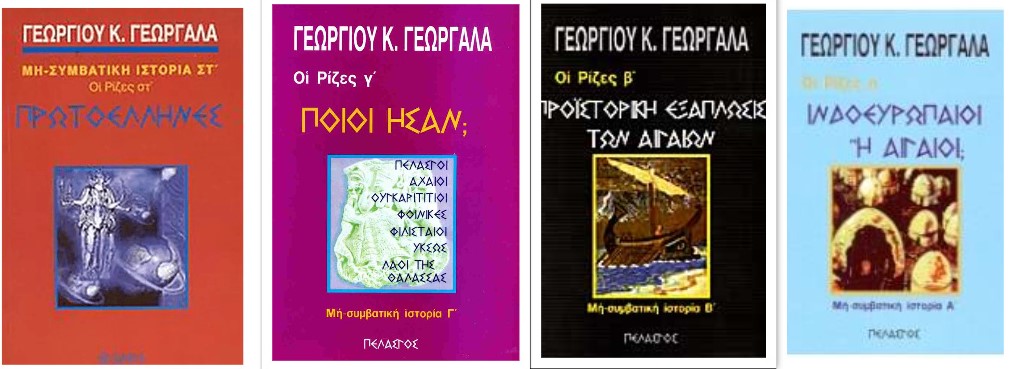
The dogma of the ‘isolated’ Greek world is a fabricated cage designed to keep the true power of our ancestors hidden. Once you break the bars of the Indo-European forgery, the evidence of a global prehistoric Hellenism becomes undeniable. We are no longer talking about local trade, but about seafaring journeys beyond the known lands, efficiently sophisticated journeys that have bridged continents. From the Ogham-coded landscapes of Ireland to the profound cultural parallels in the Jomon and Yayoi transitions of Japan, the fingerprints of the Pelasgian (Πρωτοέλληνες) travelers are there for the courageous to see.

-Japan
In the oldest Japanese historical work, the “Kojiki” (c. BC), which is an early Japanese chronicle of myths, legends, hymns, genealogies, oral traditions, and semi-historical accounts Japanese about their prehistory, it is mentioned that Susanoo, the son of the sea lord Janaki, who was exiled as a rebel from his country, which was far to the West, arrived in Japan as a civilizer. Susanoo is depicted with a bull’s head, like Cronus and the Minoans. Susanoo’s sister was the goddess Amaterasu – perhaps from the word mother?
One of the first gods of the Japanese is Omino, king of the land of the dead. Is it possible that Omino derives from the name Μίνως, the king that ancient Greeks believed to be the judge of the dead?
-Ireland
The Irish Druids claimed to be descendants of the Danaans, who taught the islanders arts and “secrets of the heavens.”
In Aran in northern Ireland, there are ruins of cyclopean walls that Irish legends say were built by “sea people” who arrived there millennia ago. “Sea people,” the Egyptians called the Greeks.
• An old Irish tradition states that on one May Day, Prince Partholon arrived on the island from Greece, from Mygdonia (= Macedonia), with twenty-four couples. The Greeks settled on the island until an epidemic wiped them out after three hundred years. After some time, the Danaan tribe (Danaoi) arrived, who landed on the plain of the menhirs: monoliths. The Danaan brought with them magical objects, a sword, a spear, a shield, and the Stone of Destiny, which spoke when the legitimate king sat on it. The Danaans were welcomed with joy by the islanders, who considered them a “divine race.”
Only the Fomore tribe fought them and were defeated. According to Danaan, the arrival of F. Giraud and J. Roth (“General Mythology”) is placed immediately after the Trojan War. Later, the Danaans returned to their homeland.
In the History and Topography of Ireland by Giraldus de Bari, we read:
“Partholon came to the shores of Ireland with his three sons and their wives for the development of agriculture; they cleared four great forests. After three hundred years, their descendants had reached nine thousand… they were almost all destroyed by an epidemic.”
• In the collection “Ancient Irish Stories” (1930), it is mentioned: “The Danaans (Danan) lived in the northern islands (ed., obviously these are those settled in the country of the Hyperboreans) engaged in science, magic, Druidism and other arts, until they surpassed all the wise men of the world. They had four cities, where they were engaged in magical arts, science, and knowledge. These were Phalia, Goria, Myria, and Findias. The Danaans came with a large fleet to Ireland.”
• In Myths and Legends of the Celtic race, T. Rolle writes: “The Milesians came from Spain” (i.e., from Tartessus).
• The Great Goddess – Mother of the Irish, was called Danou (Danae), and of the Britons Don.
The word Dan(aos) plays an important role among the northern peoples.
• Denmark – Dan, Don (= king of the Danes), Dan (= Scots nobleman), Dan (= god of the Scandinavians), Bo-dan (= god of the Germans), Don (Goddess and river of the Scythians).
More vital pieces of evidence came from a foreign researcher, the German professor of Linguistics, Mr. Nors S. Josephson, who, after eight years of research, summarized his findings in the English-language book “Greek Linguistic Elements in The Polynesian Languages – Hellenicum Pacificum”, published by the historic German University of Heidelberg, 1987, in which he listed a table of 808 ancient Greek words, whose roots are in the Polynesian languages.
As we look closely, the Moai amazingly resemble the Cycladic figurines themselves. The masterpieces were created by prehistoric Greek travelers. Moai, otherwise known as Mata Kita Rana, meaning Eyes Looking at the Sky. Combine them with the findings of the research of the German Nors Sigurd Josefsson, that the languages of Polynesia and all of Indonesia emerged from ancient Greek.

2) The forgery “Phoenician” Origin of the Alphabet: This dogma seemed strong until about 100 years ago, when linguists and historians still claimed that the Greeks did not know writing before 800 BC! Around 1900, however, Arthur Evans excavated Greek Minoan Crete and discovered the Greek Linear Scripts, whose symbols were identical in shape to at least 17 of the 24 letters of the Greek Alphabet. Given a) that the oldest examples of these Greek scripts (Linear A and B), which were subsequently discovered in Pylos, Mycenae, Menidi, Thebes, and further north, up to the Danube line, were then dated before 1500 BC and b) that the Phoenicians and their script appear in history no earlier than 1300 BC, Evans, in his work Scripta Minoa, was the first to express doubts about the truth of the theory that the Greeks received writing from the Phoenicians, while at the same time expressing the scientific suspicion that the opposite probably happened.
The doubts about the Phoenicians not having priority over the Greeks in the discovery of writing became certain when Professor Paul Fore, an international authority on Prehistoric Archaeology, published an announcement in the American archaeological journal, published by the University of Indiana, Nestor (year 16, 1989, p. 2288), in which he lists and deciphers Greek Linear Writing tablets, found in excavations on the Cyclopean wall of Pilikata in Ithaca and dated by modern methods to 2700 BC. The language of the tablets is Greek, and Fore’s decipherment rendered the syllabic text phonetically as follows: A]RE-DA-TI. DA-MI-U-A-. A-TE-NA-KA-NA-RE(ija)-TE. This phonetic rendering is always translated, according to the French professor: “Here is what I, Aredatis, give to the goddess Rhea: 100 goats, 10 sheep, 3 pigs.” Thus, Fore proved that the Greeks were writing and speaking Greek at least 1400 years before the appearance of the Phoenicians and their writing in history.
But the archaeological excavations in Greece over the last 12 years have yielded many other great surprises: The Greeks were writing not only their syllabic Linear A and B scripts but also a type of writing identical to that of the Alphabet since at least 6000 BC. Indeed, in Dispilio, in the waters of Lake Kastoria, Professor G. Hourmouziadis discovered an inscribed tablet with writing almost identical to the alphabet, which was dated by modern methods of radioactive carbon (C14) and optical thermoluminescence to 5250 BC. Three years later, the Superintendent of Prehistoric and Classical Antiquities, N. Samson, while excavating the “Cyclops Cave” on the deserted island of Gioura, Alonissos (Northern Sporades), discovered fragments of vessels (“ostraca”) with letters identical to those of the current Greek Alphabet, which were dated by the same methods to 5500-6000 BC. The same archaeologist, while conducting excavations on Milos in 1995, discovered “early Cycladic vases” from the middle of the 3rd millennium BC, which bore identical letters of the Greek Alphabet Χ,Ν,Μ,Κ,Ξ,Π,Ο,Ο,Ε. It is obvious that these archaeological discoveries not only gave a comical character to the so-called “Phoenician Theory” about the discovery of writing, but also fundamentally overturn the entire official chronology of Greek History, as it is taught, and also the official world History of Civilization.
The Flood of Ogygus and the Two Cadmuses
While researching, I discovered that the “First Athens” was reportedly built near Lake Copais (Kopaida) under the reign of King Ogygus. This civilization was ultimately buried by a cataclysmic flood, and Ogygus was lost to the depths. Historical traditions claim that he later founded Eleusis, while his son, Cadmus I (the King of Boeotia), established another great city known as Cadmeia. It remains uncertain if he was the one who fortified it, but the settlement bore the name Cadmeia until approximately 3000 BC, when it was renamed Thebes.
These accounts are supported by Athanasius of Stagira in Ogygia or Archaeology (Volume 4, page 222) and can be found in the Suda (Suidas) Lexicon under the entry for “Ogygia.”
The Chronology of the Two Cadmuses
Tens of thousands of years purportedly passed between the time of Cadmus, son of Ogygus, and the arrival of Cadmus, son of Agenor. By the time the latter appeared, the original Cadmeia had fallen into ruin and been deserted. Aware of the site’s history, Cadmus of Agenor rebuilt it from its foundations, populating the city by gathering inhabitants from neighboring villages.
Later historians largely ignored the state of the ruins Cadmus found upon his arrival. While some may have known the prehistory, they likely viewed the subject as a desecration or a taboo. Following his death and the reigns of his successors, the city was renamed Thebes—honoring either the wife of Ogygus or Thebe, the daughter of Zeus.
The Date and the Phoenician Question
Cadmus of Agenor lived well before 3078 BC. We know he predates the Trojan War era because Homer mentions his daughter, Ino, in the Odyssey (Book 5, 348).
Centuries later, a third, more controversial figure appeared: Cadmus of Miletus, the historian and son of Pandion. As a scholar, he likely studied the scripts of the ancient antediluvian civilizations from finds in Phoenicia. He refined these characters into their “correct” forms and brought them to Greece.
A Critique of Herodotus
It is worth noting that Herodotus often drifted into digressions regarding foreign customs and geography. His Histories contain inaccuracies and traditions that were impossible to verify at the time. In his book Terpsichore, he writes extensively about Cadmus as a “Phoenician” bearer of letters. However, ancient thinkers like Plutarch, Aristotle, Harpocration, and the Egyptian priest Manetho criticized Herodotus, accusing him of being prone to recording inaccuracies and “evil deeds” (malice) in his narratives.
Plus, let’s delve into the ancient Greek historian Diodorus Siculus ,known for writing the monumental universal history Bibliotheca historica:
Fifth Book.74.Ταῖς δὲ Μούσαις δοθῆναι παρὰ τοῦ πατρὸς τὴν τῶν γραμμάτων εὕρεσιν καὶ τὴν τῶν ἐτῶν σύνθεσιν τὴν προσαγορευομένην ποιητικήν. πρὸς δὲ τοὺς λέγοντας, ὅτι Σύροι μὲν εὑρεταὶ τῶν γραμμάτων εἰσί, παρὰ δὲ τούτων Φοίνικες μαθόντες τοῖς Ἕλλησι παραδεδῶκασιν, οὗτοι δ ̓εἰσὶν οἱ μετὰ Κάδμου πλεύσαντες εἰς τὴν Εὐρῶπην, καὶ διὰ τοῦτο τοὺς Ἕλληνας τὰ γράμματα Φοινίκεια προσαγορεύειν, φασὶ τοὺς Φοίνικας οὐκ ἐξ ἀρχῆς εὑρεῖν, ἀλλὰ τοὺς τύπους τῶν γραμμάτων μεταθεῖναι μόνον, καὶ τῇ τε γραφῇ ταύτῃ τοὺς πλείστους τῶν ἀνθρῶπων χρήσασθαι καὶ διὰ τοῦτο τυχεῖν τῆς προειρημένης προσηγορίας.*Διοδώρου Σικελιώτου Ιστορική Βιβλιοθήκη
The conclusion in simple words: The Alphabet is 100% indigenous Greek.
3)The Slander of “Human Sacrifice”: The attempt of some priests and “progressives” to identify antiquity with barbaric sacrifices is the ultimate distortion. Archaeology refutes the daily practice of such atrocities. Sacrifice in ancient Greece (and in Saint Seiya) was a symbolic transcendence of the “ego”, not bloodshed. The obsession with this myth only serves those who want to present Hellenism as a “darkness” that needed external rescue.
4)The Ghost of Fallmerayer: Although scientifically dead, Fallmerayer’s doctrine survives subcutaneously in academic circles that resent the word “Greek continuity.” The insistence that there is no biological or cultural connection to the ancient Greeks creates a permanent insecurity, turning the modern Greek into a “stranger” in his own home. While DNA research (e.g., on Minoans and Mycenaeans) confirms genetic stability in our area, the elite insists on a narrative of “invaders”, as if our nation and culture are random and not an organic evolution of thousands of years.
When Georgiades Adonis joined New Democracy in 2012, he became just a compromised man with those dogma supporters. An attack henchman who now shares space with those who support those doctrines.
Animation as an Act of Reclaiming: In Japan, anime does not question the nation’s indigeneity; it celebrates it. If Greece were taught its history not as a series of “borrowings” but as an unbroken biological and spiritual continuity (as DNA research linking modern Greeks to the Minoans and Mycenaeans confirms), then animation would become the vehicle for bringing out this indigenous power.
This loss of confidence isn’t just a modern phenomenon—it’s rooted in historical narratives that downplay Greek genius contributions to world civilization.
Consider that Herodotus (B’ 128)mentions that the ancient Egyptians linked the construction of pyramids to a figure called ‘Filitios.’ Ancient stories narrate that when they were building the pyramids, the supervisor of the works was the prehistoric Greek Aimοn(Alfred Cyril “Egypt to the end of old kingdom” London, Thames and Hudson,1978). Whιch he was the son of the Pelasgian Chlorus(Lexicon of Stephanus Byzantious, word Αιμονία). The Aimons were a prehistoric Greek tribe from Epirus, who journeyed and settled in Thessalia, and thus it was named Aimonia.
The 9th-century historian Ibn Abd al-Hakam Futuh Misr (The Conquest of Egypt), we read: “Surid, the son of Egypt’s King, Salhouk, about 300 years before the cataclysm, together with the priest Akiman, built two pyramids. He ordered the priests to insert within them all the wisdom and the scientific knowledge they possessed. He did so to preserve the signs for future generations.”
-When did the cataclysm happen, that it’s the same as that of Deucalion: On 9.564 bC.
Surid is another accent way for the name Kourites, yes, the prehistoric Greek tribe. The Kouretes were mythical guardians of Crete (and Phrygia), known as the “watchful guards” of Zeus, who hid his birth from Kronos by dancing armed dances. They were considered the first inhabitants of Crete, creators of culture, protectors of the arts, and of Zeus. They were considered inventors, as they are credited with the first social organizations, metallurgy, and the armed dance (pyrrhi). Origin: According to myth, they were children of the Earth, namely, indigenous.
Aimon -Akiman-Aklimon was the very Pelasgian ‘Filitios.’
Let’s also examine the famous episode in Egypt, when Thales of Miletus engaged in a debate with Pharaoh Amasis about the power and potential of mathematics. To convince the pharaoh, Thales was challenged to measure the precise height of the Great Pyramid—a feat the Egyptians themselves had not accomplished. Thales drove his cane into the sand and measured its shadow alongside the pyramid’s shadow. By using simple geometric reasoning, he deduced the pyramid’s height, stunning the pharaoh and demonstrating the ingenuity of Greek thought.
Daedalus was the skillful engineer, architect, and craftsman, creator of the Labyrinth on Crete. Among his inventions are: Statues empowered by quicksilver as intelligent guards of the Labyrinth, wooden empowered dolls, and an artificial cow as a mysterious device for fertility. Also outstanding are the wings for himself and his son, Icarus. Daedalus himself gave Ariadne the clue on how Theseus could escape the labyrinth. As King Minos found out about it, he imprisoned both Daedalus and Icarus in the labyrinth.
That’s why he made wings for himself and his son, and easily they escaped from this prison. Icarus disobeyed his father and began to soar upward toward the Sun, which melted the beeswax that held the feathers together, so he plunged into the sea and drowned. Afterwards, he traveled to Camicus in Sicily, where he stayed as a guest under the protection of King Cocalus. There, he built a temple to Apollo. Then he hung up his wings as an offering to the god and promised never to fly again. Minos was furious, and by sailing, he searched for Daedalus, asking for a riddle solution. He presented a spiral seashell and asked for a string to be run through it. When he reached Camicus, King Cocalus, knowing Daedalus’s ability, accepted the shell and gave it to him. As he tied the string to an ant, which, lured by a drop of honey at one end, walked through the seashell stringing it all the way through. With the riddle solved, Minos realized that Daedalus was in the court and demanded that he be handed over. Cocalus agreed to do so, but convinced Minos to take a bath first. In it, Cocalus’s daughters killed him by pouring boiling water over his body.
Nonetheless, Daedalus was very afraid of retaliation by the Cretans, so he departed for Egypt. Due to the great services he offered to the Egyptians, he was worshipped as a god.
An issue of Greece’s self-confidence is a claim that toxically undermines it: “The ancient Greeks succeeded because they gave all hard labor to their slaves, without exception!”
Let’s solve this tricky intellectual trap:
«Ἔφαγόν τε, ἔπιόν τ ε και αἰδοίοισιν ἔδωκα»
(=Έφαγα, ήπια, έδωσα και στους αιδοίους).
Οδ. Ο, 373.
The ancient commentator comments: “the servants of the house (= servants) say, because he is worthy of being a servant” (“a slave” is generally the respected one, the one worthy of protection).
This verse reveals the Greek concept of slaves. It is certainly known that ancient societies were slave-owning. The defeated enemy became the slave of the conquered one and remained in his service, unless his relatives freed him by paying a ransom.
“Concentration camps” and “prisons” did not exist. The unarmed enemy could not be left free, since) During the confrontation with the opponent (always in accordance with Greek ideals), he did not win but neither did he fall fighting (“ἤ τάν ἤ ἐπί τᾶs”). He surrendered, was declared inferior, inferior (lesser), that is, he was defeated.
In the ancient Greek language, the word “doulémporos” does not exist. Slave ships and slave trading agencies are much later.
That is why the word “doulémporos” does not exist in the ancient Greek language. Slave ships and slave trading agencies are much later, newer constructions, while it is assumed that the institution of slavery has now disappeared. Professors HANSON and HEATH, in their book “Who Killed Homer” (ed. KAKTOS), note indicatively that Aristotle would say “that Americans outlawed slavery only to treat millions of free people worse than slaves” (p. 173). Plato in the LAWS recommends, on the one hand, that Greeks should not be enslaved, and on the other hand, that slaves should be treated well. And indeed, this is exactly what happened in Greece. “Slaves” and “masters” lived harmoniously, connected with affection, care, sympathy, and intimacy, as becomes clear, again through Homer’s verses. When, for example, Telemachus returns from his journey to Sparta, the “slaves” run and kiss him lovingly on the head and shoulders (“κύνεον ἀγαπαζομεναι κεφαλέν τε και όμους”). Telemachus addresses the swineherd slave “ἄττα” (=father, grandfather), Penelope respectfully addresses the treasurer (=housekeeper) Eurynome “Μαία” (=respected mother), and the slaves address their masters by name. Eteoneus, for example, the slave of Menelaus: “ω Μενελάε” (d. 26). Hector’s slave to Hector: “Εκτωρ” (Γ,382) etc.
This is why the historian Cordatos admits: “Slaves are not slaves in the true sense of the word. They are the sons and daughters of the head of the family. Likewise, slaves are daughters and daughters-in-law, because the objective conditions have not yet matured so that useful surplus value can be derived from their labor. Labor is done jointly by all members of the genus. Even kings work with the commoners. Odysseus makes his bed alone. Telemachus engages in manual labor. Nausicaa washes her clothes with the maids in the river. The same thing happens in the vineyards and in the fields. And there they all go together and work. There are no masters and workers… »
Study carefully this antiquity below: The Ilissus stele(4th century BC), as exhibited in the National Archaeological Museum, Athens. It depicts the dead young man (hunter) facing his father, at his feet his young slave, devastated by the death of his master. If the everyday reality of the so-called slaves was dystopian, then why does the stele depict the slave’s sorrow for his dead master?

In ancient Greece, slaves performed all of the duties of janitor, cook, educator, agricultural laborer, and shepherd. The therapaenides were engaged in household chores. It is confirmed that on many public slaves performed the duties of street cleaner, policeman, messenger of the Parliament and the Court, but also the duties of executioner, because no free citizen was allowed to become an executioner or, at least, to be a policeman. The hardest working public slaves were those employed in the mills and mines of Lavrion. Usually, dishonest and bad-natured slaves were sent there as punishment. (Cf. the later “forced labor”.)
The Greeks, bearers of high culture and education, always treated slaves humanely:
“If someone is a slave, he remains a man…” (Philemon)
“If someone is a slave, he has his flesh; for by nature no slave was ever born, it is by chance that the body was enslaved.”[ Κἄν δοῦλος ᾗ τις, οὐδέν ἧττον ἄνθρωπος οὗτος ἐστίν…» (Φιλήμων)
«Κἀν δοῦλος ᾗ τις, σάρκα τήν αὐτήν ἔχει· φύσει γάρ οὐδείς δοῦλος ἐγεννήθη ποτέ, ἡ δ’ αὖ τύχη τό σῶμα κατεδουλῶσατο.»]
The mistreated slave had the opportunity to take refuge as a suppliant at the altars of the sacred temples, preferably at the altar of the Erinyes or Theseus, in which case his master was obliged to resell him. The law protected the slave just as it did the free man against violence. It even granted the slave an “advocate” for any dispute regarding the possibility of his liberation. “The Athenians, foreseeing the fate of slaves, also enacted laws in favor of slaves, which are abusive.”
Xenophon observes that:«οἱ Ἀθηναῖοι ἐποίησαν ἰσηγορίαν τοῖς δούλοις» προς τους ελευθέρους. Και ό Δημοσθένης («κατά Μειδίου») τονίζει:
«47 Ἐάν τίς ὑβρίζῃ εἰς τινα, ἤ παῖδα ἤ γυναῖκα ἤ ἄνδρα, τῶν ἐλευθέρων ἤ τῶν δούλων, ἤ παράνομόν τι ποιήσῃ εἰς τούτων τινά, γραφέσθωπρός τούς θεσμοθέτας, ὁ βουλόμενος Ἀθηναί ων…»
«48 Ἀκούετε, ῶ ἄνδρες Ἀθηναοι, τοῦ νόμου τῆς φιλανθρπίας, ὅς οὐδέ τούς δούλους ὑβρίζεσθαι ἀξιοῖ· τί οὖν πρός θεῶν; εἴ τις εἰς τούς βαρβάρους ἐνεγκῶν τόν νόμον τοῦτον, παρ’ ῶν τά ἀνδράποδα εἰς τούς Ἕλληνας κομίζεται, ἐπαινῶν ὑμᾶς καί διεξιῶν περί τῆς πόλεως εἴποι πρός αὐτούς ὅτι 49 εἰσίν Ἕλληνες τίνες ἄνθρωποι οὕτως ἥμεροι καί φιλάνθρωποι τούς τρόπους ῶστε (πολλά ὑφ ὑμν ἠδικημένοι, καί φύσει τῆς πρός ὑμᾶς ἔχθρας αὐτοῖς ὑπαρχούσης πατρικῆς) ὅμως οὐδέ τούτους ὑβρίζειν ἀξιοῦσιν, ἀλλά νόμον δημοσίᾳ τόν ταῦτα κωλύσοντα τέθεινται, καί πολλούς ἤδη παραβάντας τόν νόμον τοῦτον, ἐζημιῶκασιν θανάτω».
Ο Ευριπίδης δεν αμελεί να το υπενθύμιση ποιητικά:
«Νόμος τοῖς τ’ ἐλευθέροις ἴσος καί τοῖς δούλοις» (Εκάβη 291).
Ο Αριστοτέλης υποδεικνύει (Οίκονομ. 1344) : «…δεῖ πρῶτον δούλους παρασκευάζεσθαι σπουδαίους. Δούλων δέ εἴδη δύο, ἐπίτροπος καί ἐργάτης. Ὁμιλία δέ πρός δούλους, ως μήτε ὑβρίζειν ἐᾶν μήτε ἀνιέναι. Καί τοῖς μεν ἐλευθεριῳτέροις τιμῆς μεταδιδόναι, τοῖς δ’ ἐργάταις τροφῆς πλῆθος…» και καταλήγει:
«Χρή δέ καί τέλος ῶρίσθαι πᾶσι. Δίκαιον γάρ καί συμφέρον, την ἐλευθερίαν κεῖσθαι ἆθλον».
In the ancient Greek language, the word “slave trader” does not exist. Slave ships and slave trading agencies are much later.
“When Telemachus returns from his journey to Sparta, the ‘slaves’ run and kiss him lovingly on the head and shoulders (‘κύνεον αγαπαζομεναι κελέχεν τε και όμος’).
The law protected the slave just as it did the free man against acts of violence. It even granted the slave an “advocate” for any dispute regarding the case of his liberation.
The slave was a member of the family. He participated in prayers, religious festivals, and was buried in the family tomb.
The “Invader” Trap: If a creator’s subconscious believes he is a “stranger” in his land, his art is rootless. My journey for the real deep roots goes beyond academic narratives of “Indo-Europeans.”
To be continued in Part F’: Anime Legacy | Can we Greeks Achieve a Cultural Renaissance?: https://mangaanimeblogger.com/anime-legacy-greece-needs-its-ghibli-part-f/
Leave a Reply