Continuation from part F’: Anime Legacy | Can we Greeks Achieve a Cultural Renaissance? Anime-Legacy | Greece-needs-its-Ghibli-part F’
Anime Legacy | As I’m in the conclusion, I recall the many times of my will to talk about the value of this art, and for us to make a notable civilization. I see how I insisted on including issues and events that were silenced by a weird purpose: The valuable broadcasts of the 80s,90s, that we are indigenous; however, even on this account, there’s silence and distortion of facts.
Consider the silenced history of the Tokei Maru in 1922. In the horror of the Smyrna Catastrophe, it was a Japanese ship that threw its precious cargo overboard to save thousands of Greek lives. The New York Times reported on September 18, 1922: “The American and Japanese steamers accepted all comers without examining their papers, while the others took only foreign subjects with passports.” https://greekreporter.com/2025/09/14/the-japanese-ship-which-saved-hundreds-of-greeks-during-the-smyrna-catastrophe/ https://www.la.us.emb-japan.go.jp/e_web/2019_SmyrnaIn1922_JapaneseShip.htm
Why has this story remained in the shadows?
The omerta around this story serves multiple purposes:
1) In the same year (1922) that Greece lost Smyrna and the whole of minor Asia, Japan was emerging as a compassionate power, not just an economic or military one.
2)That Japan—not “Christian Europe”—acted with Christian charity when Greeks were dying.
3)That Greece and Japan share a valuable bond of blood from the Catastrophe.
The Tokei Maru is a bridge. It proves:
- Japan and Greece are not strangers. Japan saved the Greeks when others would not.
- Anime isn’t a “foreign invasion.” It comes from a nation that proved its friendship in blood.
- The silence around this story is part of the same erasure that silenced the animation, the Panagia, the Amazons, and the heroes.
Animation—much like the haunting beauty of Grave of the Fireflies—could finally give shape to that sacrifice. It allows us to explore archetypes and cultural memory through visual poetry that live-action often cannot reach.

We stand at a crossroads of cultural identity:
- One path is Retrenchment. Clinging to a narrow, often punitive, version of the past. This path fears animation, fears the future, and seeks strength in prohibition.
- The other path is Confident Synthesis. Embracing the discipline and craft of Japan, accepting our prehistory and ancient history, restoring the school uniform, the narrative ambition of anime, and the deep, wild, humane well of our prehistory: myth, and history to build something new, bold, and uniquely Greek.
I’m advocating for the second path. It is harder, brave. It requires believing that our Greece is a phoenix—whose ashes contain the seeds of incredible stories, waiting for the right spark to animate them.
🔟 Anime Legacy | Conclusion: Achieving an Everlasting, Fertile Civilization.
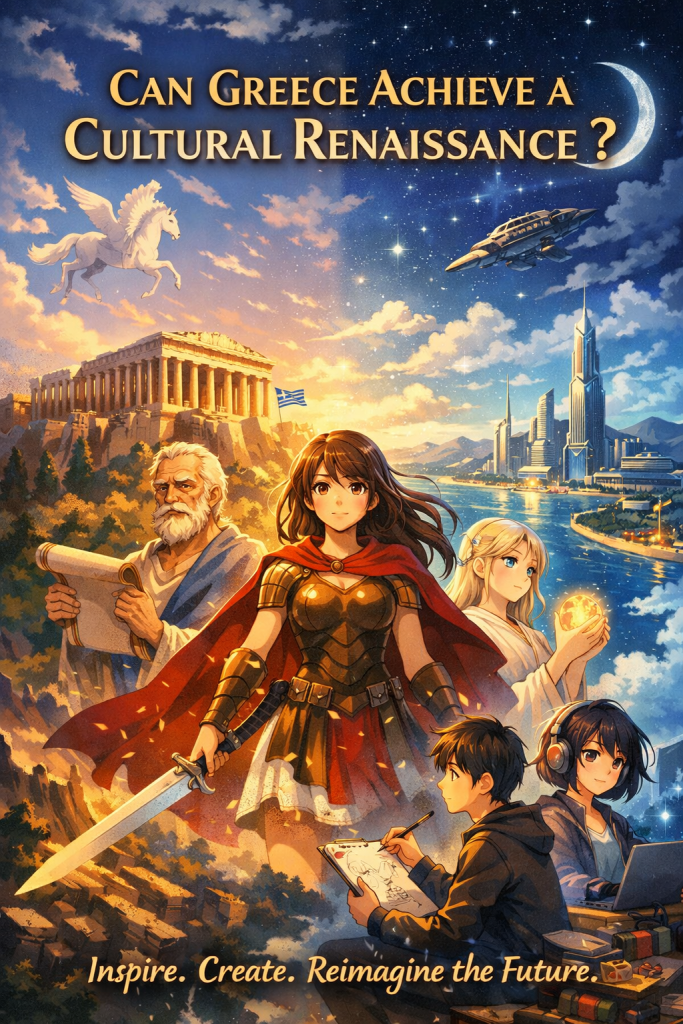
Anime provides that language. Imagine Greek anime long-term productions:
Project 1: A school-life series with uniforms, youth, students studying diligently, and stylized beauty (ecchi/fanservice as visual language, wind upskirting, slight panty shots, not sin).
Project 2: A series about a Greek kunoichi, named Phoebe, as a female warrior-mystic, the antidote to the “damsel,” serving the nation with intelligence and power.
Project 3: Magical Girls (Mahou Shoujo) ala Greek: Not only of stars and wands, but their powers could also be based on the Aegean sun or the Eleusinian Mysteries. The reaction to the pentagram or “magical” symbols is a sign of ignorance, as geometry and symbolism are part of ancient Greek science (Pythagoreans).
Project 4:The adaptation of the historical drama novella “Antones Stenemachites”[Αντώνης Στενημαχίτης], set in 1876 in Stenimachos of Philippopolis (today’s Plovdiv), which was being targeted by both Turks and Bulgarians. A forgotten work of Calliope Papathanase – Mousiopoulou.
Project 5:An adaptation of the Greek fantasy isekai novel “THE DRAGONBORN”, by author Eriella Chrysou.Aeolus publishing (εκδόσεις Αίολος, Αθήναι).
Project 6: A series where young Greek students uncover, inside the famous mountain “Pyramid of Taygetus”, ancient Titan-shaped war mechas, hidden for centuries. As they activate them with their human spirit and communal joy, they enter their cockpits and pilot them, and battle corporate drones in a struggle for the Aegean. It’s a powerful metaphor for the ancient wisdom and science to help in a critical geopolitical setting and time.
Project 7:A long series about the adventures of the action girl Arlene, opposing the scheming, nefarious ‘Hunter Corporation’. Based on the OC of my fellow Greek writer, illustrator Maria, on https://www.deviantart.com/lethielart . Arlene is a badass, fighting girl with untapped potential https://www.deviantart.com/lethielart/art/in-action-510640214. In fact, with Maria’s written permission, I made a manga version of the action girl “I Fight All Of You”: https://www.deviantart.com/xxthe-needed-manxx/art/I-Fight-All-Of-You-851449496. Embrace the discipline and craft of Japan. If you are inspired to craft your own narratives, check out these guides on Writing Fantasy & Science Fiction (https://amzn.to/3QxA9ma),by Orson Scott Card (Author), Philip Athans (Author), Jay Lake (Author) . “Outlining Your Novel: Map Your Way to Success (Helping Writers Become Authors) “,by K. M. Weiland (Author), (https://amzn.to/4uiwpDt) on Amazon to help build your own symbolic worlds. Also, explore how to write profound fiction stories of fighting girls: “Fight Like a Girl: Writing Fight Scenes for Female Characters”,by Aiki Flinthart (Author) : https://amzn.to/3QInKf5
Below: A cover of an 80s volume of the magazine “Hana To Yume”, featuring Princess Lum as an ancient Greek goddess, and Ataru in ancient Greek.

https://mangaanimeblogger.com/?page_id=1488
Can we achieve a lasting renaissance?
First, animation must be recognized as an industry. It requires long-term investment, training pipelines (for animators, writers, and music creators), and a belief in intellectual property. And as a valuable form of cultural capital, rather than merely superficial juvenile entertainment. It demands coherence, patience, and the will to treat imagination as a national asset. Animation departments in our industry can collaborate with our Universities and art schools. Public broadcasting could commission short animated works rooted in our mythology, history, and contemporary narratives. Small studios could be supported through tax incentives and co-production agreements with European partners. Festivals and digital platforms could showcase domestic creators, allowing talent to remain rather than emigrate.
The National Council for Radio and Television, namely NCRTV, regulates broadcasters, not creators. So we don’t need their approval to create a web-based anime, a YouTube series, a streaming release, or a crowdfunded short. Greek law regulates video-sharing platforms, but the primary burden falls on the platforms, not on independent creators. The first Greek anime does not need to air on ERT. It can premiere on YouTube, Patreon, or a dedicated website. We should build the audience, prove a fanbase demand.
Law 4779/2021 implements the EU Audiovisual Media Services Directive. This means:
- The Greek framework cannot be more restrictive than EU law requires without justification.
- EU law emphasizes protection from gratuitous violence and pornography—not from stylized youthful aesthetics.
The valuable art I defend is often misunderstood because it speaks the language of imagination openly. Where live-action storytelling, within limitations, tends to imitate everyday reality, animation is free to explore archetypes, myth, and symbolic worlds without apology. For this reason, it has become one of the most powerful narrative forms of the modern era, capable of expressing philosophical ideas, emotional depth, and cultural memory through visual poetry. Yet societies sometimes struggle to recognize this power. Across different countries and periods, imaginative media—from comics to animation—have been dismissed as childish, trivial, or culturally suspect. Such reactions reveal less about the medium itself and more about the limits a culture places on its own imagination.
The lesson is not that one nation should imitate another. Japan did not develop its animation culture by accident, but through decades of artistic experimentation and social acceptance of visual storytelling as a serious craft. What matters is not copying Japan, but rediscovering a willingness to nurture imagination.
For us, a civilization whose heritage includes its timeless antiquity, epic poetry, and symbolic storytelling, this should not be an immoral idea. The Amazon, the seeress, the hero, the philosopher—these archetypes were once central to our cultural imagination. Animation simply reminds us that such figures still have a place in modern storytelling. The beauty of anime lies not only in its artistry but in its courage to dream. If we learn to approach it not with suspicion but with curiosity, we may rediscover something essential: that imagination is not an escape from culture, but one of the ways culture renews itself.
We’re not alone. The Makeleio article [https://www.makeleio.gr/%ce%b5%cf%80%ce%b9%ce%ba%ce%b1%ce%b9%cf%81%ce%bf%cf%84%ce%b7%cf%84%ce%b1/%cf%84%ce%b1-%cf%86%ce%bf%ce%b2%ce%b5%cf%81%ce%ac-%ce%ba%ce%b9%ce%bd%ce%bf%cf%8d%ce%bc%ce%b5%ce%bd%ce%b1-%cf%83%cf%87%ce%ad%ce%b4%ce%b9%ce%b1-%cf%84%cf%89%ce%bd-%cf%80%ce%b1%ce%b9%ce%b4%ce%b9%ce%ba/ ] proves that nostalgia for 90s animation is widespread. The hunger is real, and the silence/omerta is enforced by a small, aging elite. They cannot hold forever.
The question, ultimately, is not whether anime is superior to live-action drama, nor whether we should imitate Japan. The deeper question is whether we still recognize imagination as a serious cultural force, and for truth, kindness, and justice. Animation, at its best, does what myths once did: it gives shape to courage, transformation, sacrifice, and discovery. For decades, as an audience, we have proved receptive to such storytelling — from the broadcasts of the 1980s and 1990s to the continuing global popularity of animated narratives today. To dismiss animation as childish is therefore not a defense of cultural maturity; it is a narrowing of cultural possibility.
Call To Action

A confident civilization does not fear imagination. It cultivates it. Perhaps the rediscovery of animation, manga, and imaginative storytelling is not a foreign influence at all, but an opportunity for us to reconnect with something it once understood very well: the power of myth, symbol, and creative vision.

To the Greek creators reading this:
- The NCRTV is a wall. Don’t waste your energy knocking—find a way around it.
- Create for the internet first. Build a community and an audience that cannot be ignored.
- Document the double standards. Show what is allowed in live-action and what is condemned in animation.
- Leverage the EU’s legal framework: the law protects against gratuitous violence and pornography, not against stylized beauty or youthful vitality.
- Remember, the first Greek anime won’t debut on ERT. It will premiere online—on YouTube, on social media, wherever your audience lives. When your work is loved and shared, the gatekeepers will have no choice but to pay attention
To the viewers :
Demand equal standards from NCRTV. If live-action gets a pass on adultery, why is “ecchi” in animation singled out?
Support Greek animators—follow them, back them on Patreon, boost their pilots, and spread the word.
Break the silence. The Greek kunoichi is coming—approval or not.
If this essay has resonated with you, I invite you to continue with the journey. Revisit an anime series you once loved. Discover a work you have never seen before. Or simply reflect on how animation has shaped your own imagination and sharpened your daily routine. We are not starting from scratch. Giannis Roumboulias, with the film “The DragonPhoenix Chronicles: Indomitable,” threw the first spark, showing that a Greek creator can build an entire epic world. However, one “Dragonphoenix” is not enough to resurrect an entire industry. We don’t want more “alone” projects struggling with the indifference of the channels. We want an alliance.
What role do you believe animation should play in our modern culture?
Do you think societies sometimes underestimate the artistic and philosophical depth of animated storytelling?
Feel free to share your thoughts in the comments or recommend works that deserve attention. Cultural renaissance begins with curiosity—and sometimes with the courage to rediscover forms of art we once overlooked.
Bibliography
Animation & Media
- Lamarre, Thomas. The Anime Machine: A Media Theory of Animation.
- Denison, Rayna. Anime: A Critical Introduction.
- Schodt, Frederik L. Dreamland Japan: Writings on Modern Manga.
- Condry, Ian. The Soul of Anime: Collaborative Creativity and Japanese Media Culture.
Culture & Civilization
- Η αποκάλυψη της αρχαίας Ελληνίδας: Η κατάρριψη των μύθων.Εκδόσεις Εύανδρος ,2006[The revelation of the ancient Greek woman: Debunking the myths.Evandros Editions, 2006 ]
- Williams, Raymond. Culture and Society.
- Hyde, Lewis. The Gift: Creativity and the Artist in the Modern World.
- Crawford, Matthew B. The World Beyond Your Head.
- Saito Tamaki The Beautiful, Fighting Girl (Sentō bishōjo no neseigaku).
- Η άγνωστη προϊστορία των Ελλήνων, Παντελής Ιωαννίδης (εκδόσεις Δίον, 2003)[The unknown prehistory of the Greeks, Pantelis Ioannidis(Dion Editions, 2003)]
- Διοδώρου Σικελιώτου Ιστορική Βιβλιοθήκη.
- Οψεις του Σύγχρονου Πολιτισμού Ιαπωνικές επιρροές. Εκδ. Παπαζήσης.[Aspects of Contemporary Culture Japanese influences. Papazeses Editions ]
- Nors Sigurd Josephson, “Greek Linguistic Elements in The Polynesian Languages – Hellenicum Pacificum”, published by the historic German University of Heidelberg, 1987
- Ωγυγία ή Αρχαιολογία, Aθανάσιος Σταγειρίτης.
- Οινωψ Πόντος[The Wine Dark Sea.”Homer’s Heroic Epic of the North Atlantic”] Henriette Mertz . Εκδόσεις Νέα Θέσις,
Japan
- Dower, John W. Embracing Defeat: Japan in the Wake of World War II.
- Ikigai: The Japanese secret to a long and happy life. By Héctor García, Francesc Miralles. Penguin Books (Hutchinson/Penguin Life)
Greek Context
- Woodhouse, C.M. Greece in the Twentieth Century.
- Kalyvas, Stathis N. Modern Greece: What Everyone Needs to Know.
Childhood & Aesthetics
- Bettelheim, Bruno. The Uses of Enchantment.
Leave a Reply